Advanced Liquid Package Solution
Any question?
Get in touch


An edible oil filling line moves clean, empty containers through filling, closing, inspection, labeling, and packing. Its configuration depends on the oil, the package, the required output, and the way the finished quantity will be verified. A useful comparison starts with project data and defines the conditions behind the quoted machine speed.
The edible oil filling machine is the center of the line, but it does not work alone. Bottles must arrive in the correct orientation, remain stable during filling, accept the specified closure, and pass through labeling and packing at a compatible rate.
Stage | Main function | Information to confirm |
Bottle feeding | Place empty bottles onto the conveyor in a controlled flow | Bottle material, dimensions, shape, handle, stability, and infeed method |
Oil filling | Meter the required quantity into each container | Oil properties, filling temperature, quantity basis, fill range, and target output |
Cap feeding and capping | Sort, place, and apply the closure | Cap and neck drawings, samples, liner, torque or application requirement |
Sealing and inspection | Add a tamper-evident step where required and check the filled pack | Induction seal or other seal, checkweigher, leak check, rejection rules |
Coding and labeling | Apply production information and the retail label | Code content, label material, bottle surface, label position, and inspection |
Secondary packing | Prepare bottles for storage and distribution | Case or film format, pack pattern, pallet handling, and required output |
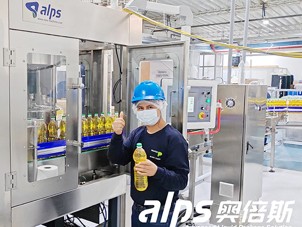
ALPS presents filling, capping, labeling, and packing within its edible oil filling line. Its D'oro Oil project in Peru documents bottle unscrambling, filling and capping, labeling, carton packing, checkweighing, and pallet stretch wrapping in one delivered configuration.

An ALPS edible oil bottling line running at the D'oro Oil plant in Peru. The equipment scope shown is project specific. Image source: ALPS D'oro Oil project.
Start by defining whether the accepted quantity is based on volume, net weight, or another agreed measurement. This choice determines how filling and verification will work.
Filling method | What it measures | Selection considerations |
Volumetric displacement | A defined volume for each filling cycle | Suitable when volume is the project basis. Confirm the oil's flow behavior, fill range, product path, cut-off, and changeover method. |
Net-weight filling | Product mass measured with a load cell during filling | Useful when the package is controlled by net weight or the buyer wants direct mass measurement. The proposal should define weighing conditions, tare handling, rejection, and calibration. |
Other metering arrangements | Depends on the proposed meter, pump, or control logic | Ask the supplier what is measured, how the target is controlled, and how performance will be demonstrated with the actual oil and container. |
ALPS identifies its SNYG equipment as a volumetric edible oil filling machine. Net-weight systems use load cells to measure delivered mass and suit projects that specify quantity by weight. Compare the methods using the same oil, package, target quantity, and test conditions.

ALPS automatic volumetric filling equipment for bottled oil applications. Final configuration depends on the product, container, closure, and required output. Image source: ALPS SNYG-8 product page.
Edible oils can behave differently as temperature and product composition change. Give each supplier the normal operating condition and the most demanding condition the line must handle.
The project data should include:
· Oil names and the number of products planned for the line
· Normal and minimum filling temperatures
· Viscosity or flow data across that temperature range
· Density when volume-to-weight conversion or weight control is relevant
· Any flavor particles, herbs, or other inclusions
· Product supply pressure, tank location, and available flow
· Cleaning method and the sequence for changing from one oil to another
These details guide the product path, metering arrangement, nozzle design, fill sequence, and cleaning access.
A nominal volume does not fully describe a bottle. The supplier also needs its material, dimensions, weight, shape, base, handle, neck finish, and stability. Light or irregular bottles may need additional guidance through the line.
Provide approved bottle and cap samples whenever possible. The cap application method must match the neck and closure. If the package uses an induction liner or another tamper-evident feature, include the sealing and inspection step in the line scope.
Oil on the bottle mouth or thread can interfere with closing and leave residue on the package. Evaluate nozzle cut-off, filling height, bottle position, and cap timing together. Oil on the outer surface can also affect label application.
Every capacity figure should identify the bottle size, oil, filling condition, and line scope. Bottles per hour alone does not show the required liquid flow.
Required liquid flow (L/h) = bottles per hour × fill volume (L)
At 3,000 bottles per hour, a 1-liter bottle requires 3,000 L/h. A 5-liter bottle at the same rate requires 15,000 L/h and may need different filling, supply, handling, and downstream arrangements.
Ask for the expected output of each priority SKU and confirm that capping, labeling, inspection, and packing can sustain it. Include cleaning, changeovers, and normal stops in shift planning.
The technical agreement should define the reference oil, bottle, cap, fill quantity, test period, reject treatment, and acceptance method.
Food-contact parts should be accessible for cleaning and compatible with the oil and cleaning materials. The product path should support inspection, draining, and controlled restart. Frequent oil changes may require a different cleaning and recovery arrangement from a dedicated line.
For US food operations, 21 CFR 117.40 requires food equipment to be adequately cleanable, made from suitable materials, maintained, and installed for cleaning and maintenance access. The plant's food-safety team should reflect these requirements in the specification and procedures.
Clean nozzle cut-off reduces oil around the bottle neck and machine. Ask how the system handles filling start and stop, drainage, residual product, and out-of-tolerance packages. For changeovers, review the required parts, tools, settings, access, and verification.
A standalone filler can fit a plant with compatible bottle handling, capping, labeling, packing, conveyors, and controls. Define every mechanical, electrical, control, and product-supply interface.
An integrated edible oil bottling line places those interfaces within one coordinated scope. It can simplify layout, controls, speed matching, and acceptance testing. The quotation should identify included equipment, utilities, site work, installation, training, and production support.
Project route | Appropriate starting point | Main checks |
Standalone filling machine | Existing packaging line with confirmed compatible equipment | Infeed and discharge heights, speed signals, bottle transfer, product supply, controls, guarding, and acceptance responsibility |
Integrated filling line | New line or major packaging-line replacement | Complete machine list, line balance, layout, utilities, controls, inspection, packing, installation boundaries, and total acceptance test |

Illustrative ALPS oil filling line layout. Actual machine sequence, dimensions, and downstream scope must be confirmed for the project. Image source: ALPS edible oil solution.
Include the following information in the request for quotation:
· Oil list, samples, filling-temperature range, viscosity or flow data, and density where relevant
· Target fill quantities and whether acceptance is based on volume, net weight, or another method
· Bottle and cap drawings, physical samples, label details, and complete SKU list
· Required output for each bottle size and the planned shift schedule
· Filling, capping, sealing, coding, labeling, inspection, packing, and pallet scope
· Product supply, power, compressed air, drainage, floor space, and conveyor direction
· Cleaning, product-change, and format-change expectations
· Required documentation, factory testing, training, installation, commissioning, and site acceptance
It can when the approved oils, fill range, bottles, closures, and changeovers fit the selected configuration. The proposal should list required change parts and settings and state the expected output for each priority format.
Use the quantity basis required for the package. Volumetric equipment meters a defined volume, while a net-weight filler measures delivered mass. Compare them using the same oil conditions, target, tolerance, verification procedure, output, and line scope.
Send representative oil, empty bottles, caps, liners, labels, and a finished-package example. Add drawings and specifications for each priority SKU so the supplier can check flow behavior, bottle stability, neck and cap fit, and label position.
A reliable proposal begins with a defined oil, package, quantity basis, output, cleaning plan, and line boundary. Prepare those inputs before comparing equipment so each supplier is quoting the same job. ALPS can review them against its edible oil filling machine and complete-line options.


By continuing to use the site you agree to our privacy policy Terms and Conditions.