Advanced Liquid Package Solution
Any question?
Get in touch


A flow meter filling machine measures liquid as it moves through the product circuit and stops each fill at a programmed target. It offers flexible electronic adjustment, but its performance depends on the meter, liquid, valve, and supply conditions working together. This guide focuses on the choices that matter when specifying a beverage or liquid filling system.

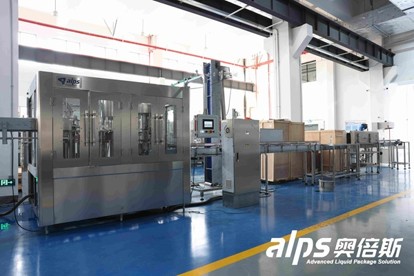
ALPS beverage filling line equipment showing the filler within a connected packaging line. Source ALPS Machinery
A flow meter filler controls the dose from an accumulated volume or mass signal. The controller compares that signal with the recipe target and closes the dosing valve at the cutoff point. It may also compensate for liquid that continues moving while the valve closes.
A typical cycle has four stages:
1. A tank or pump supplies the product under controlled conditions.
2. The liquid passes through a flow meter, which sends a volume-flow or mass-flow signal to the controller.
3. The controller totals the measured quantity and commands the valve to slow or close as the target approaches.
4. The container leaves the station for capping, inspection, labeling, or packing.
The meter is one part of the control loop. Product pressure, tank level, valve response, and machine settings also affect the final dose.[2] ALPS lists flow meter filling and mass meter filling among the available beverage and liquid filling methods, alongside gravity, isobaric, volumetric, and weighing systems.[1]

Container handling inside an ALPS rotary beverage filler. Source ALPS Machinery
Electromagnetic and Coriolis meters are the two main options for beverage and liquid filling. The choice starts with the product's conductivity, density, gas content, viscosity, and required measurement basis.
Selection point | Electromagnetic flow meter | Coriolis mass flow meter |
Measurement | Volume flow | Mass flow; many devices also report density and temperature |
Product requirement | The liquid must meet the meter's minimum conductivity | Works with conductive and non-conductive liquids |
Common fit | Water, many juices, milk-based drinks, and other conductive liquids | Oils, low-conductivity liquids, products with changing density, or recipes controlled by mass |
Main checks | Full pipe, conductivity, grounding, coating, and air bubbles | Entrained gas, pressure drop, vibration, sizing, and cost |
An electromagnetic meter generates a voltage when a conductive liquid moves through a magnetic field. That signal is converted into volume flow.[3] The measuring tube must remain full, and the liquid must meet the device's conductivity limit. Very low-conductivity water, non-conductive oil, air pockets, or electrode coating can make the reading unstable.
A Coriolis meter measures the phase shift created as product flows through vibrating tubes. It reports mass flow directly and can often provide density and temperature data.[4] Conductivity is not required, which makes Coriolis useful for oils and other non-conductive liquids. Entrained air and two-phase flow can still disturb the measurement.

ALPS stainless steel filling valves. Valve response and product supply conditions influence the final dose. Source ALPS Machinery
Flow-meter filling can handle many pumpable liquids, but the product name alone is not enough for selection. Test the actual liquid at its filling temperature and include representative samples in the project review.
Product | Likely starting point | Important check |
Still water, juice, tea, and similar drinks | Electromagnetic filling when conductivity is sufficient | Conductivity, foam, temperature, and full-pipe condition |
Edible oil and other non-conductive liquids | Coriolis, piston, servo volumetric, or net-weight filling | Viscosity, density change, container size, output, and cleaning |
Carbonated drinks | A pressure-compatible filling process with suitable flow measurement | Carbonation, temperature, flashing, foam, and pressure control |
Products with pulp, fibers, or particles | Application-specific meter, valve, and nozzle selection | Particle size, concentration, settling, and passage diameter |
Purified and reverse-osmosis water deserve a conductivity check because very low conductivity can reduce electromagnetic meter performance.[5] Carbonated products need pressure control in addition to measurement. ALPS can filling equipment distinguishes flow measurement from isobaric filling, so both requirements should appear in the specification.[6]

ALPS can filling equipment. Carbonated products require pressure control as well as a suitable measurement method. Source ALPS Machinery
Meter accuracy does not equal machine accuracy. The delivered fill and line output also depend on:
· Meter sizing and the operating flow range.
· Stable product pressure and tank level.
· Valve closing time, wear, and nozzle dribble.
· Air, foam, and two-phase flow.
· Temperature-related changes in density and viscosity.
· Recipe setup and verification with production samples.
· Bottle infeed, capping, inspection, labeling, and downstream line balance.
A quotation should separate the meter specification, filling repeatability, and guaranteed production output. Ask for the test product, fill size, speed, sampling method, and acceptance criteria behind each figure.
Filling method | How the dose is controlled | Typical reason to choose it |
Flow meter | Electronic measurement of volume or mass in the product line | Recipe flexibility and measured filling without a fixed dosing chamber |
Gravity or level | Product flows by gravity or stops at a set level | Free-flowing liquids or a consistent visible fill height |
Piston or servo volumetric | A defined mechanical volume is displaced | Viscous products or positive-displacement dosing |
Net weight | Load cells measure the filled container | Large containers or products sold and controlled by weight |
Each method controls a different production variable. Bottle variation matters for level filling; seals and change parts matter for piston systems; conveyor motion affects net-weight filling. The wider beverage filling machine selection guide explains how carbonation, temperature, foam, particles, container format, and hygiene influence the complete machine choice.[7]
A useful request for quotation gives the supplier enough data to size the meter, valve, nozzle, product circuit, and machine layout.
· Product description, conductivity, density, viscosity, and filling temperature.
· Carbonation, foam, entrained-air risk, and any particles or fibers.
· Cleaning chemicals, cleaning temperature, and CIP or SIP requirements.
· Container drawings, dimensions, neck finish, closure, and samples.
· Fill volumes, legal tolerance, and target repeatability.
· Required output for every container and fill size.
· Number of products and changeovers.
· Available utilities, floor space, and upstream or downstream equipment.
· Destination-market hygiene, electrical, and safety requirements.
Ask the supplier to state the assumptions behind the quoted speed. A result based on water in a small bottle may not represent a warm, foamy, viscous, or particle-containing product.
During commissioning, test the actual product and container at planned speeds. Verify meter zero, valve timing, cutoff compensation, repeatability, and foam behavior against a suitable reference. The maintenance plan should also cover drainability, seals, valve seats, meter connections, electrode condition or grounding on magnetic meters, and vibration or entrained gas around Coriolis meters.
A flow meter filling machine works best when the meter, supply, valve, container handling, and line controls are specified as one system. Start with measured product and package data, then compare magnetic, Coriolis, and alternative filling methods against the same duty. Share those details with ALPS to discuss a suitable configuration.
It can use either basis. An electromagnetic meter measures volume flow. A Coriolis meter measures mass flow directly and may calculate volume from mass and density. Net-weight filling is different because load cells weigh the container instead of measuring flow in the product pipe.
Many systems can store recipes for several fill volumes. Bottle handling, neck position, nozzle travel, capping, and conveyor settings may still require adjustments or change parts. Confirm the full container range as well as the meter's measurement range.
Set the interval from the meter documentation, plant quality system, product risk, use frequency, and verification history. Routine checks against a known reference can identify drift before results move outside the accepted tolerance.


By continuing to use the site you agree to our privacy policy Terms and Conditions.