Advanced Liquid Package Solution
Any question?
Get in touch


A soft drink production process connects beverage preparation with container handling, filling, closing, and packaging. In a carbonated drink production line, temperature, pressure, and CO2 conditions must remain controlled from the carbonator to the closed bottle or can. Buyers also need to match the equipment to the product, package, required output, and available utilities.
A carbonated soft drink production line is a connected system that prepares the beverage and packages it for distribution. It commonly includes water treatment, syrup preparation, blending, cooling, carbonation, filling, closing, labeling, and secondary packaging. Cleaning, inspection, transfer, and line controls support these operations.
Production line, bottling line, and filling machine describe different scopes. In equipment catalogs, soft drinks bottling may refer to container preparation through finished-package handling. Soda manufacturing also includes beverage processing. The filling machine only transfers the prepared drink into bottles or cans.
This scope affects the quotation. Buyers should confirm whether a proposal includes water treatment, syrup preparation, a carbonator, cooling, conveyors, labeling, packing, utilities, installation work, and controls. ALPS presents these modules within its complete carbonated beverage production line.
The sequence varies with the recipe, preservation method, package, and plant design. Some lines combine blending, deaeration, cooling, and carbonation in one preparation system. Others divide them among several units.
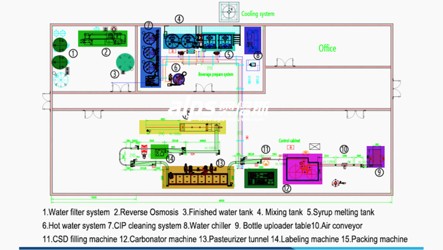
Example ALPS carbonated beverage line layout. The final process and equipment scope depend on the product, package, preservation method, and site conditions. Image source: ALPS carbonated beverage solution.
Stage | Main job | Typical equipment | Information to confirm |
Water treatment | Prepare process water to the product specification | Filtration, activated carbon, softening or membrane treatment as required, storage and transfer | Raw-water analysis, finished-water target, peak demand |
Syrup and ingredients | Dissolve, filter, dose, and blend ingredients | Sugar dissolver, syrup tank, filter, dosing equipment, mixing tank | Recipe range, batch size, solids, cleaning needs |
Beverage preparation | Blend water and syrup, remove air where required, cool, and carbonate | Blender, deaerator, heat exchanger or chiller, carbonator, buffer | Product flow, target carbonation, inlet conditions |
Container preparation | Supply suitable bottles or cans to the filler | PET bottle blower and air conveyor, depalletizer, bottle or can rinser | Material, dimensions, neck finish, container quality |
Filling and closing | Fill under controlled pressure and close promptly | Isobaric filler, capper or can seamer, monoblock | Product condition, closure, fill level, speed |
Post-fill handling | Inspect the package and apply product-specific treatment | Inspection equipment and, where required, warmer or tunnel pasteurizer | Preservation process, package tolerance, quality plan |
Coding and packing | Identify and protect the finished product | Date coder, labeler, shrink wrapper or case packer, palletizer | Label, code, pack pattern, distribution needs |
Cleaning and control | Clean product-contact systems and coordinate equipment | CIP or cleaning circuits, sensors, conveyors, line controls | Cleaning scope, changeovers, interface responsibility |
Water treatment should be selected from the incoming water analysis and the required finished-water quality. The syrup room then prepares a consistent beverage base by dissolving, filtering, and dosing ingredients. The University of Michigan's soft-drink equipment reference also separates ingredient preparation, syrup mixing, blending, and carbonation into distinct operations.
The product and container follow separate routes until they meet at the filler. PET bottles may be blown from preforms on site, while glass bottles and cans may arrive on pallets for depalletizing, inspection, and rinsing. After filling and closing, the package moves through coding, labeling, packing, and palletizing.
Carbonation normally occurs upstream of the filler. A carbonator mixes CO2 into the conditioned beverage, which then travels through sanitary piping to the pressure filler. ALPS lists beverage carbonation as the function of its carbonated beverage mixing machine.

ALPS carbonated drink mixing and carbonation equipment. Image source: ALPS carbonated beverage solution.
Changes in pressure or temperature during transfer can release dissolved CO2. This may cause foam, slow filling, variable fill levels, or product loss. The route from the carbonator to the filler needs stable flow, suitable cooling, controlled pressure, and limited agitation.
An isobaric filler brings the container close to the product-tank pressure before liquid enters. This reduces the sudden pressure change that releases CO2. Controlled decompression and prompt capping or seaming complete the package. The ALPS guide to isobaric filling explains the filling sequence in more detail.

Rotary filling equipment used in an ALPS carbonated beverage line. Image source: ALPS carbonated beverage solution.
Package material changes container preparation, filling-machine configuration, closing, inspection, and conveying. A supplier needs approved container and closure information before confirming the equipment.
Package | Container preparation | Closing method | Main planning points |
PET bottle | Receive finished bottles or blow them from preforms | Plastic cap | Bottle design, neck finish, compressed air if blowing, change parts, label type |
Glass bottle | Depalletize, inspect, then rinse or wash as required | Crown cap or specified closure | One-way or returnable bottle, bottle condition, impact-resistant handling |
Aluminum can | Depalletize and rinse | Double seam | Can and end dimensions, seamer setup, seam inspection |
A rinser and a returnable-bottle washer perform different jobs. The rinser prepares suitable empty containers immediately before filling. A washer carries out the more demanding cleaning required for returned bottles.
Multi-format projects may share beverage-preparation or downstream equipment, but each package needs a defined route. The proposal should identify shared and dedicated modules, change parts, conversion time, and expected output for every approved format.
Line sizing starts with saleable output, container volume, production schedule, and package mix. Bottles per hour alone cannot describe the required beverage flow.
Required beverage flow (L/h) = containers per hour × container volume (L)
For example, 6,000 bottles per hour at 500 mL requires 3,000 L/h reaching the containers before allowances for startup, product loss, or downtime. At 1.5 L per bottle, the same container rate requires 9,000 L/h. The blender, carbonator, cooling system, transfer system, and filler must all support the relevant flow.
The slowest sustained stage limits the line. A filler will stop if the carbonator cannot supply enough conditioned product or if the labeler and packer repeatedly back up. Compare the sustained output, container range, accumulation, and changeover time of every connected machine.
Nameplate speed also differs from saleable shift output. Production planning must account for startup, cleaning, changeovers, maintenance, and normal stops. The technical agreement should define the reference product, container, test duration, inlet conditions, and acceptance method used to confirm output.
A useful request for quotation defines both the beverage process and the packaging scope. Include:
· Beverage types, recipe categories, and preservation assumptions
· Target carbonation and filling condition, if established
· Container material, dimensions, volume range, drawings, and samples
· Neck finish, cap, crown, or can-end specification
· Required output for each product and package
· Shift pattern and changeover frequency
· Raw-water analysis and required process-water quality
· Available power, water, compressed air, CO2, cooling, drainage, and floor space
· Cleaning boundaries and equipment interfaces
· Coding, labeling, inspection, packing, and palletizing requirements
· Documentation, testing, training, installation, commissioning, and acceptance expectations
Define the finished sales pack early because labeling and packing affect line speed, accumulation, floor space, and labor. Each quoted output should also name its reference product, package, and test conditions.
For a US plant, equipment and layout must support the facility's food-safety controls. 21 CFR 117.40 requires food equipment to be adequately cleanable, use suitable food-contact materials, and allow access for cleaning and maintenance. The project team must also identify any other federal, state, and local requirements that apply to the product and facility.
Some water-treatment, mixing, packaging, and conveying equipment may be shared. Carbonated and still drinks can require different product preparation, filling conditions, preservation processes, and cleaning sequences. A multi-product proposal should show the route, shared modules, dedicated equipment, changeover method, and output for each beverage.
The required post-fill process depends on the formula, microbial risk, preservation method, filling conditions, package, shelf-life target, and distribution plan. The beverage developer and food-safety team should define that process before the equipment list is finalized.
A useful project brief connects the beverage, package, capacity, utilities, cleaning plan, and finished pack before equipment is selected. Prepare these inputs first, then compare complete scopes and acceptance conditions. ALPS can review them against its carbonated beverage production-line configuration.


By continuing to use the site you agree to our privacy policy Terms and Conditions.