Advanced Liquid Package Solution
Any question?
Get in touch


Before requesting a water filling line quotation, define the production duty, packaging formats, equipment boundary and site conditions. Then tell suppliers how to present their prices, exclusions and technical exceptions. Without that shared basis, two offers can look competitive while covering different projects.
This RFQ checklist focuses on PET bottled-water lines. It helps investors, purchasing managers and engineers prepare a usable request for quotation without prescribing a machine model before the application is understood.
Write down where the supplier's responsibility starts and ends. Does the project begin with raw water and preforms, treated water and purchased bottles, or an existing upstream system? Does delivery end at capped bottles, wrapped packs or finished pallets? Mark each package as required, optional, existing or buyer-supplied.
• Production equipment: Identify treatment, storage, bottle blowing or feeding, rinsing-filling-capping, labeling, coding, inspection, packing and pallet handling where needed.
• Auxiliaries and connections: Assign compressors, air treatment, chillers, cleaning systems, conveyors, piping, cabling and interface controls explicitly. Do not assume that the word 'turnkey' includes them all.
• Integration responsibility: Name who connects each package and demonstrates the combined operation, especially when existing machines or several suppliers are involved.
Sidel's line-integration overview treats equipment specification, utilities, controls and installation deliverables as connected engineering tasks. In an RFQ, translate that principle into named interfaces and deliverables, not just a list of machine prices.

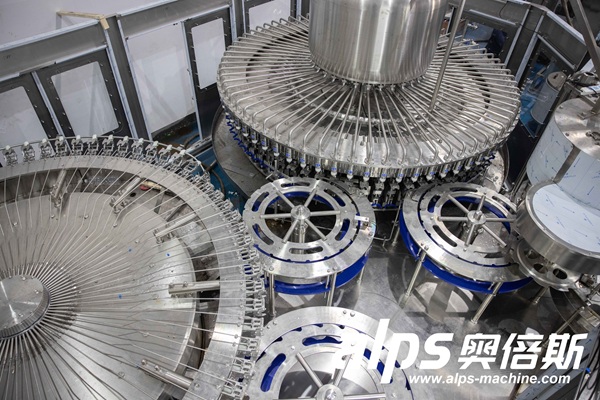
A rinsing-filling-capping block is one equipment package. The RFQ should identify which upstream, downstream and auxiliary systems are also required.
Specify required bottles per hour for each reference SKU, daily saleable output, shifts and available production time. Identify whether the target applies at the filler discharge or after final packing. Keep current demand separate from future expansion and ask the supplier to state the conditions behind each offered rate.
If the target is not yet established, use the guide to selecting water filling line capacity. The RFQ should contain the resulting duty, rather than simply request the fastest available machine.
Prepare a SKU sheet with one row per bottle-and-pack combination. Attach controlled drawings and identify whether they are approved or preliminary. List bottle volume, material, weight, overall dimensions and neck finish; cap type and drawing; label construction, dimensions and position; and bottles per pack, arrangement, film, tray or carton.
State whether preforms, molds and finished bottles already exist, and who will supply each. Include handle or tethered-cap features where relevant. Confirm bottle and cap compatibility requirements [Internal link pending → Article 05: PET Bottle and Cap Compatibility for Water Filling Lines] before treating a format as fixed.
Ask suppliers to distinguish routine adjustments from separately priced change parts, molds and format trials. Different bottle volumes should not silently inherit the same offered speed or changeover scope.

Bottle volume alone does not define a format. Supply neck and body drawings, closure details and representative samples for the proposed handling system.
Identify the water source, intended finished product, filling conditions and required product-quality specification. If treatment is included, attach a current source-water analysis with sampling date and location, available flow and known seasonal variation. Ask what further testing is needed; a source name alone is not a treatment design basis.
For an existing treatment plant, provide the delivered-water specification and connection conditions instead. Keep any sparkling-water, flavored-water or special filling requirement explicit so suppliers can identify whether it changes the proposed process and equipment. Do not assume every water product needs the same treatment train.
Send a dimensioned building drawing showing usable height, columns, doors, access routes, existing equipment and connection points. Identify the installation country, environmental conditions and any restrictions on delivery, lifting or shutdown work. A total floor-area figure cannot show whether a proposed arrangement fits.
Record available voltage, phase and frequency; electrical capacity; compressed-air conditions; water supply; and drainage information. Use the water filling line utility requirements to organize these inputs without guessing missing values.
Require the supplier to return a preliminary utility schedule, connection requirements and layout assumptions. For an undeveloped site, distinguish required utility provision from what is already available, and identify who designs and installs the infrastructure.
Describe the required operating functions, not only an automation label. State expectations for material replenishment, changeovers, inspection and rejection, data recording and connection to existing controls. Request the assumed staffing and manual tasks for the offered configuration; 'automatic' does not mean unattended.
List product-contact material documentation, cleaning arrangements, safety requirements and destination-specific evidence to be reviewed by the relevant specialists. Define the requested fill, closure, label and pack quality outcomes. Ask suppliers to identify proposed acceptance criteria and exceptions; detailed FAT/SAT procedures can be developed against that agreed basis.
Include manuals and HMI language, software-backup scope, training, startup consumables, recommended spares and special tools. Separate installation supervision from physical installation labor, and identify travel, accommodation, local assistance and additional service-day charges. Request warranty start conditions, coverage, exclusions and the support process in writing.


By continuing to use the site you agree to our privacy policy Terms and Conditions.