Advanced Liquid Package Solution
Any question?
Get in touch


A water filling line FAT and SAT checklist should connect every acceptance requirement to a test, a measurable result and a responsible signatory. Factory acceptance testing checks the supplied equipment before shipment. Site acceptance testing checks the installed configuration under actual plant conditions. A short demonstration run cannot establish all three: machine functionality, sustained line performance and production readiness.
For PET bottled-water projects, the practical objective is to verify agreed output and package quality while documenting what remains untested. Use the following checklist as a planning framework, then adapt the protocol to the purchased scope.
FAT can cover individual machines or an assembled line at the supplier's facility. SAT follows installation and commissioning at the buyer's plant. The boundary matters: a filler tested with a temporary conveyor has not demonstrated the performance of the final labeler, packer and controls together.
The published scope of IEC 62381:2024 distinguishes acceptance and integration tests for process-industry automation systems and supports project-specific test plans. It is a useful reference for controls scope, not a universal bottled-water acceptance specification or a substitute for the purchase agreement.
Prepare an approved protocol with requirement IDs, test methods, instruments, sampling, pass limits, witnesses and sign-off authority. Define the bottle format, operating rate, test duration, output-counting point and treatment of stops. State which interfaces are real, simulated or deferred to SAT.
Align these conditions with the specifications buyers should include in an RFQ. Acceptance should verify the agreed purchase basis, rather than introduce new performance expectations on test day.
For equipment-selection questions beyond acceptance, see how to choose a bottled water filling machine. Here, keep the review focused on demonstrating the selected configuration against its agreed requirements.
Identify test batches of preforms or bottles, caps, labels and packing materials. Provide enough for setup, measured runs, changeovers and retesting. Check PET bottle and cap compatibility before scheduling the trial; unapproved substitutes can invalidate the intended demonstration.
Record the test-water condition and any difference from production. Agree which SKUs represent difficult handling, filling or packing conditions. A successful run with one bottle does not automatically qualify every format listed in the sales proposal.
• Scope and identity: Compare machine models, serial numbers, installed options and change parts with approved drawings and equipment lists. Review accessible product-contact surfaces, seals, piping and material documentation required by the order.
• Mechanical functions: Demonstrate bottle transfer, rinsing, filling, cap feeding and discharge with approved samples. Check for collisions, bottle damage, abnormal leakage and unreliable feeding across the agreed operating range.
• Controls and protection: Have qualified personnel test operating modes, alarms, emergency stops, guard interlocks and controlled restart under an approved safe procedure. Do not bypass safeguards or reach into moving equipment to create a fault.
Record expected and observed responses, not merely that a button was pressed. The UK's HSE guidance on equipment inspection emphasizes risk-based checks and installation-dependent safety. Destination-specific requirements and the machine risk assessment still govern the actual safety-verification scope.

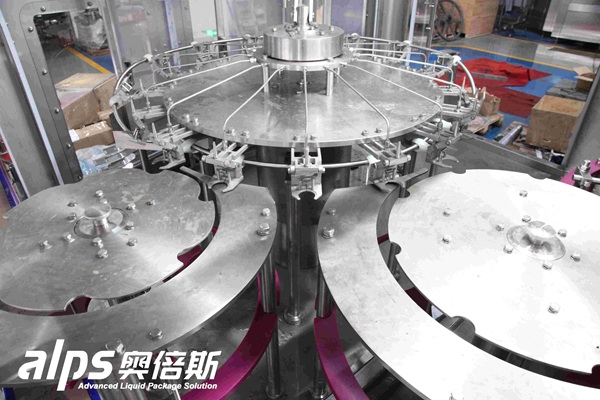
Rinser and transfer components to review during mechanical checks. Acceptance testing must also demonstrate bottle handling and rinsing with the approved materials.
Define the measurement window before starting. Record accepted output, rejects, stops and interventions at the agreed delivery point. For a complete line, count acceptable finished packs or their bottle equivalent; a filler counter alone cannot prove packed output. Keep planned fault challenges separate from the endurance run unless the protocol explicitly includes them.
Test item | What to demonstrate | Evidence to retain |
Sustained output | Agreed SKU and rate over the specified run, with utilities recorded | Start/end counts, elapsed time, rejects and stop log |
Fill quantity | Samples across the run and relevant filling positions, using the agreed method | Individual measurements, limits and instrument ID |
Closure quality | Cap seating, tamper-band condition, specified torque and leak checks | Sample IDs, test conditions and results by defect |
Label and pack | Correct artwork/code, label position, pack count and specified pack integrity | Reference samples, measurements and defect records |
Inspection/reject | Known defects tracked to confirmed removal; agreed fault responses | Challenge IDs, detections, rejects and missed events |
Changeover | Approved format change followed by stable acceptable output | Elapsed time, parts, settings, labor and startup scrap |
Apply numerical limits from the approved specification, not an unsourced universal tolerance. For cap testing, distinguish the capper setting from measured application or removal torque. Identify the method and time after capping. For changeover timing, agree whether the interval runs from the last acceptable old-format pack to stable acceptable new-format production.

The capping heads have adjustment scales. A setting on the head is not a measured torque result from a finished bottle; verify closures using the agreed test method.
Begin with installation readiness: transport condition, assembly, alignment, utility connections and closure of relevant FAT findings. Recheck functions affected by shipment, rewiring, software changes or connection to other machines before the measured site run.
• Utilities under load: Confirm electrical supply at the equipment, compressed-air pressure and specified quality at use points, water supply conditions, and drainage during operating and cleaning demand. Record actual conditions against the approved utility schedule.
• Integration and recovery: Run the purchased line with site materials and operators. Demonstrate agreed starvation, downstream blockage, communication faults and restart scenarios using controlled procedures. Verify tracking and reject functions across machine boundaries.
• Cleaning and hygiene: Demonstrate cleaning access, drainage and specified cleaning sequences. Where CIP is supplied, check the required operating records and instruments. Sequence completion alone does not establish cleaning effectiveness or microbiological suitability; retain the separately agreed verification plan.
If a site condition is outside specification, document the deviation and affected tests. Diagnose the cause before assigning responsibility. Do not claim acceptance of an untested interface simply because its simulated FAT signal worked.

Pneumatic components are one point of dependence on site air. During SAT, verify the specified supply conditions under load, not only the compressor's nominal rating.
Use a punch list that gives each finding an ID, impact, owner, correction deadline, retest requirement and closure evidence. Separate passed, failed, not tested and not applicable; a checked box should never conceal a deferred test. Keep the original failed result alongside the retest.
The Allpax factory acceptance testing white paper includes documentation, operator training and maintenance review alongside machinery trials. For a water line, request the as-built drawings, manuals, approved recipes, software backups, calibration records, spares list and training record relevant to the supplied scope.
Keep shipment release, site acceptance and permission to release production as distinct decisions. Do not operate with unresolved safety-critical defects. Any permitted noncritical open items need explicit conditions and closure responsibility; commercial sign-off does not replace the plant's product-quality release process.
There is no universal duration. Set it around the equipment, operating conditions and failure modes the trial must expose, with enough materials to complete the agreed test. A brief speed demonstration is not equivalent to an endurance run, and the observation window should not change after results are known.
Yes, if witnesses can identify the equipment, observe the agreed procedures and access measurements and event records. Plan camera coverage, instrument views and sample handling beforehand, and assign a competent local witness where needed. Edited video highlights alone cannot establish what happened throughout a measured run.
Agree a format matrix based on handling differences, closures, labels and packing configurations. Representative testing can reduce repetition, but its justification and exclusions must be explicit. A size range in a brochure does not demonstrate that all intermediate designs or different neck finishes have been accepted.
Include people able to judge engineering, operations, maintenance and quality requirements, with qualified safety support for the relevant checks. Name who records evidence and who can accept deviations. A purchasing representative may coordinate the visit, but should not be expected to assess every technical result alone.
Not by itself. Equipment acceptance addresses its defined scope; commercial product release also depends on the plant's water-quality, hygiene, packaging and applicable compliance checks. Keep commissioning and challenge-test bottles under control, and let the responsible quality team determine their disposition rather than treating them as normal saleable stock.


By continuing to use the site you agree to our privacy policy Terms and Conditions.