Advanced Liquid Package Solution
Any question?
Get in touch


Inline inspection systems for bottled water lines should be selected by the defect they must detect, not by camera count alone. Fill-level, cap, label and leak checks answer different questions. Each also needs bottle tracking and reliable rejection so a detected defect cannot continue into packing.
For buyers, the useful specification is a defect-to-action plan: what is unacceptable, where it can be measured, which method suits the bottle, and how removal is confirmed. This guide focuses on filled PET water bottles, rather than empty-container inspection or water-treatment monitoring.
Use the bottled water production process as the sequence reference. Fill-level and closure checks normally follow filling and capping; label and code checks follow the operation that creates them. Leak-detector placement depends on the test method and the package condition it needs.
Check | Typical inspection approach | Important limit |
Fill level | Vision or a suitable dedicated level sensor | Fill height is not a direct net-volume measurement |
Cap | Presence sensing; multi-view closure vision | Visible condition does not prove sealing or torque |
Label and code | Vision, pattern matching and code reading | Presence alone does not establish correct identity |
Leak | Qualified squeeze/rigidity or headspace-pressure method | Suitability depends on the actual package and process |
A combined station can reduce installation space, but shared hardware does not remove these limits. Check that labels, guides, water droplets or adjacent bottles do not obstruct the measurement area, and leave enough controlled conveyor space for the reject mechanism.
For clear PET bottles, a vision system can compare the visible liquid boundary with upper and lower limits in the active product recipe. Bottle ribs, reflections, bubbles, tilt and moving liquid can complicate that boundary. Assess the actual bottle under production lighting and motion, not only a dry, stationary sample.
Choose the station location so the measurement is repeatable after filling. If the liquid boundary is obscured, ask the supplier to demonstrate an alternative sensing arrangement. Changing sensor type does not eliminate the need to validate the bottle, product and installation together.
Keep fill-height screening separate from net-content verification. Bottles with different internal geometry can hold different volumes at the same apparent height. Where mass or volume is the release criterion, maintain the corresponding measurement method; for weight-based checks, account for packaging tare and relevant product conditions.

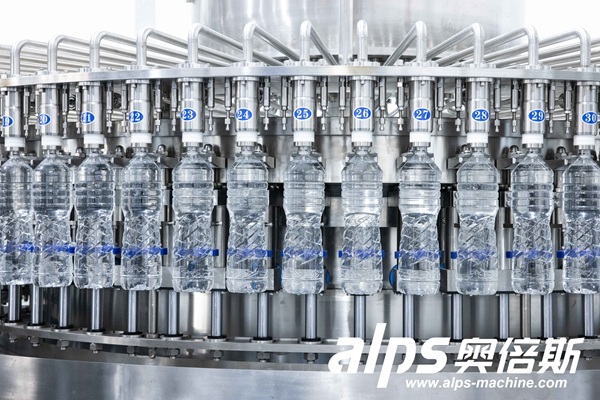
Process context: PET bottles at the filler. Fill-level inspection is a separate check; the visible filling stations are not an inspection system.
Specify the closure faults separately: missing cap, high or tilted cap, wrong color, damaged shell, and visible tamper-band defects. A simple presence sensor can answer a narrow question; inspection around the circumference may require multiple views and lighting suited to the closure.
For example, Pressco's full plastic bottle inspection system uses multi-camera coverage for fill-level and applied-closure checks, with listed defects including high caps and damaged tamper bands. This is a manufacturer-specific capability, not evidence that every camera station detects the same faults.
Do not accept 'cap present' as proof of a sound seal. A cap may look correctly seated while the sealing interface is defective. Keep visual inspection, torque verification and leak testing as distinct controls, and qualify changed cap colors or tethered features against the inspection recipe.

Process context: bottles under capping heads. Downstream vision checks the applied closure; its appearance alone does not verify torque or leak tightness.
Separate missing labels from skew, incorrect height, inverted artwork, wrinkles, lifted edges and wrong product identity. Pressco's label inspection overview lists missing, skewed and upside-down labels among its inspection targets and places modules after or within the labeler.
Specify the artwork features or codes that establish the correct SKU. For printed dates and batches, optical character recognition reads characters; character verification checks them against expected content. A readable code can still be wrong if the inspection system and printer both receive an incorrect job value, so validate the approved production reference.
Glossy labels, transparent materials and changing bottle orientation need suitable illumination and coverage. Inspect the printed area after coding, wherever that operation sits in the line. Do not assume a label-presence sensor also verifies the date or barcode contents.

The front-right sample has an inverted label, illustrating why label presence and label orientation need separate checks. This photo is not a detector test result.
An inline camera generally cannot prove that a sealed bottle has no small leak. Leak detection needs a measurable response associated with seal integrity, and the selected method must distinguish that response from normal package variation.
For flexible, non-pressurized containers, a squeeze-based system applies controlled compression and evaluates the bottle's response. Antares Vision Group's TB2000 description explains rigidity measurement under belt compression, with configurations addressing variable rigidity and optional fill-level compensation. Bottle stiffness and fill condition therefore belong in the application review.
For nitrogen-dosed water bottles, headspace-pressure inspection offers another approach. Antares Vision Group's PCS WATER describes laser-based pressure measurement after bottling. That is an application-specific option, not a reason to assume every still-water line uses nitrogen or can use the same detector.
Ask what leak condition can be detected at the intended speed, fill level, temperature and time after capping. A newly formed small leak may not yet create a measurable pressure difference. Challenge the proposed installation with representative defects; do not turn 'micro-leak detection' into an unsupported universal sensitivity claim.
Detection is only the first decision. The system must track the identified bottle to the reject point, remove it without disturbing acceptable neighbors, and confirm the outcome. Pressco's rejection-device range illustrates air, push and diverter options; the appropriate mechanism depends on container stability, mass, spacing and flow.
Require a defined response to missing inspection results, lost tracking, failed reject confirmation, a full reject container or loss of reject actuation. The agreed response should prevent potentially uninspected or defective bottles from being released, using controlled rejection, a line stop and product hold as appropriate.
Confirm operation during consecutive defects, speed changes and stop-start conditions, not only an isolated reject. Review bottling line speed matching when specifying inspection and rejection capacity. A camera's advertised processing rate does not establish the installed station's bottle-handling capability.
Agree representative acceptable samples, known defects and borderline cases for each SKU. Evaluate false rejects of good bottles separately from missed defective bottles; an overall 'accuracy' percentage can hide poor performance on an uncommon but important fault.
Retain defect categories, reject confirmation events, recipe revisions and relevant images or measurements. Investigate repeated patterns by time or machine position where reliable correlation is available. Use controlled permissions for recipe changes so a nuisance alarm is not resolved simply by loosening a threshold.
Put the agreed fill-level, closure and leakage challenges into the water filling line acceptance checklist [Internal link pending → Article 07: Water Filling Line FAT and SAT Checklist: What to Test Before Final Acceptance]. That document should define the detailed test protocol, sample quantities and acceptance criteria for the installed configuration.
No. Inspection coverage and defect-detection capability are different. A station can examine every passing bottle yet miss a defect outside its validated view, sensitivity or recipe. Evaluate defined defect categories and operating conditions, rather than interpreting '100% inspection' as a zero-defect guarantee.
Not automatically. Hidden surfaces and the rear of a cap or label may need additional views, mirrors or controlled orientation. Ask for a coverage demonstration using defects at different positions around the actual package, including the areas partly obscured by guides or handling components.
Often, but available conveyor space is only one constraint. Review bottle spacing, vibration, washdown exposure, lighting, controls and the reject path together. Confirm that the proposed station can operate across the existing speed range and that the supplier accepts responsibility for its interfaces.
No. Fill, cap, label and leak checks address specified packaging conditions; they do not establish microbiological or chemical water quality. Keep the plant's treatment, hygiene and product-testing controls separate, with defined responsibilities for deciding whether a production lot can be released.
Review the inspection recipe, expected label and code values, measurement regions and reject handling. Confirm performance with the new bottle and closure rather than copying the old setup unchanged. Preserve the approved version and repeat the agreed checks before releasing production under the new configuration.
Share bottle samples, closure and label variants, line speeds and the defects you need to control with Alps Machine. Use that information to discuss inspection locations, suitable specialist equipment and integration responsibilities, with defined evidence for both detection and confirmed removal.


By continuing to use the site you agree to our privacy policy Terms and Conditions.