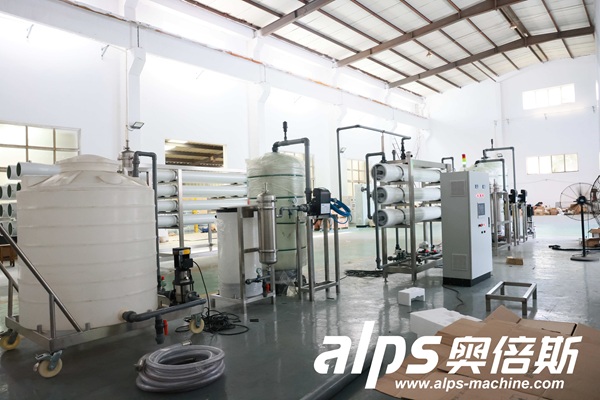
A water treatment system process is a complete sequence that turns raw water into water suitable for drinking, beverage production, or bottled water filling. It usually includes raw water testing, pre-treatment, filtration, membrane separation, disinfection, and controlled storage. In other words, it is not a single filter or one machine, but a connected purification workflow designed according to the quality of the incoming water.
In bottled water production, different water sources require different treatment routes. Municipal water may need chlorine removal and final sterilization, while well water or underground water may require hardness control, iron removal, reverse osmosis, or stronger microbial treatment. A professional water purification process should be based on actual water quality data, not a fixed equipment list.
The main purpose of the drinking water treatment process is to reduce suspended solids, turbidity, odor, color, hardness, dissolved salts, microorganisms, and other potential contaminants. Each stage has a clear role: pre-treatment protects the system, membrane filtration improves purity, and disinfection helps control microbial risks before filling.
For a bottled water treatment system, the process directly affects water taste, product safety, filling stability, and equipment service life. A well-designed water treatment system process also helps reduce membrane fouling, scaling, downtime, and long-term operating costs.
Raw Water Analysis: The Starting Point of Process Design
Before selecting RO, UF, or a UV sterilization unit, a professional water treatment system process should begin with raw water analysis. The quality of incoming water determines which treatment steps are necessary, which equipment should be installed, and how stable the final water quality will be during bottled water production. Without water quality testing, a system may be over-designed, under-designed, or unable to solve the real problem in the water source.
Common Raw Water Sources
Different water sources bring different treatment challenges. Municipal water is usually more stable, but it may contain residual chlorine, odor, or pipe-related impurities. Well water and underground water often contain hardness, iron, manganese, or higher mineral content. Spring water may have good taste but still needs microbial control and filtration before filling.
River, lake, or surface water usually has higher turbidity and organic matter, so it often requires stronger pre-treatment. Brackish water contains higher dissolved salts, which usually makes reverse osmosis more important in the process design. This is why water source treatment should always be based on the actual source, not a fixed machine list.
Key Water Quality Parameters
Several indicators directly affect the design of a bottled water treatment system. TDS in water treatment shows the level of dissolved minerals and salts; if TDS is high, RO is usually needed. Turbidity reflects suspended particles and may require multi-media filtration before membrane treatment. Hardness, mainly caused by calcium and magnesium, can lead to scaling, so a softener or anti-scaling system may be necessary.
pH, conductivity, iron, manganese, organic matter, microbial indicators, and residual chlorine should also be checked. For example, high residual chlorine can damage RO membranes, while high microbial risk increases the importance of UV and ozone disinfection. A reliable raw water analysis helps match each treatment step with a clear technical purpose.
Pre-Treatment Process: Protecting the Main Purification System
After raw water analysis, the next step in a water treatment system process is pre-treatment. This stage does not usually produce the final purified water by itself. Its main role is to protect the main purification equipment, especially UF membranes, RO membranes, UV units, storage tanks, and pipeline systems.
A well-designed pre-treatment water system can reduce particles, chlorine, hardness, and other substances that may cause blockage, scaling, membrane damage, or unstable operation. In bottled water production, this step is closely related to long-term running cost because poor pre-treatment often leads to frequent filter replacement, RO membrane fouling, lower water output, and more downtime.
Multi-Media Filter
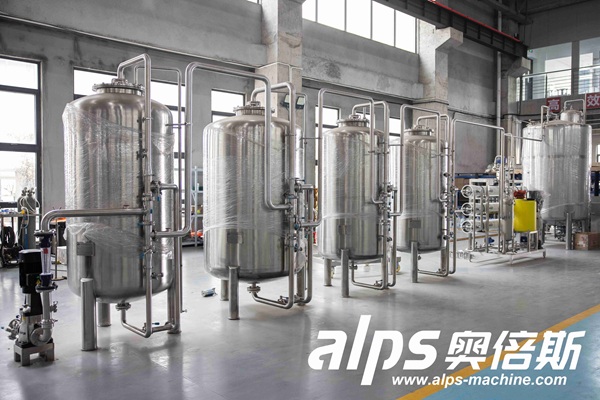
The multi-media filter is often the first major filtration unit in an industrial water treatment system. It usually contains several layers of filter media, such as quartz sand, anthracite, or other granular materials. As raw water passes through the filter bed, larger impurities are trapped before the water enters more sensitive equipment.
This process mainly removes sand, rust, suspended solids, large particles, and part of the turbidity. For well water, underground water, or surface water, this step is especially important because these sources may carry visible particles or sediment. By stabilizing the inlet water quality, the multi-media filter reduces the load on later filters and helps the entire system run more smoothly.
Activated Carbon Filter
The activated carbon filter is mainly used to improve water taste and remove substances that are difficult to handle with simple sand filtration. It can reduce residual chlorine, odor, color, and some organic compounds. For bottled water and beverage production, this stage is important because taste and smell directly affect the final product experience.
When municipal water is used as the raw water source, the activated carbon filter becomes even more critical. Residual chlorine is commonly present in tap water, but it can damage RO membranes over time. Removing chlorine before reverse osmosis is one of the basic requirements for RO membrane protection.
Water Softener or Anti-Scaling System
Hardness control is another key part of pre-treatment. Hard water contains calcium and magnesium ions, which can form scale on RO membranes, pipes, pumps, and valves. Once scaling occurs, the system may show lower flow rate, higher pressure, and reduced purification efficiency.
A water softener or anti-scaling system helps reduce this risk. A softener replaces hardness ions, while an anti-scaling system helps control scale formation through dosing. The right choice depends on raw water hardness, system capacity, and the final water quality target. In practical projects, hardness control is often the difference between a stable RO system and one that requires frequent cleaning.
Membrane Filtration Process: UF and RO Explained
Once pre-treatment has reduced particles, chlorine, and hardness risks, the next major step in the water treatment system process is membrane filtration.
UF and RO are both membrane-based technologies, but they solve different water quality problems. Understanding this difference is important because choosing the wrong membrane process can affect water taste, system efficiency, and final bottled water quality.
UF, or ultra filtration, uses a membrane with very fine pores to remove suspended solids, colloids, bacteria, and some large organic molecules from water. In a bottled water treatment system, UF is often used when the goal is to improve clarity and reduce microbial risks while keeping part of the natural mineral content.
However, the UF water treatment process does not significantly reduce TDS. This means dissolved salts, small ions, and many minerals can still remain in the treated water. For spring water or mineral water projects, this can be useful because the process helps control turbidity and bacteria without removing too many minerals that contribute to taste.
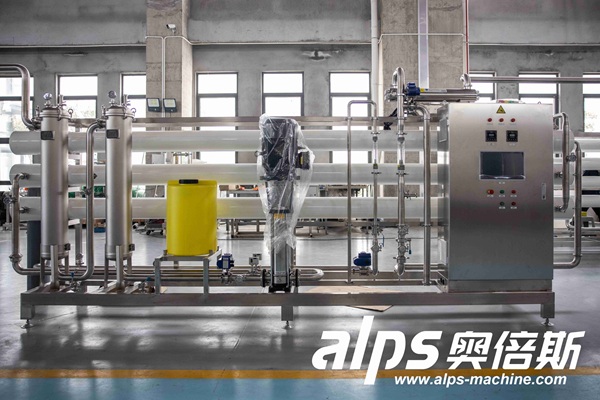
RO, or reverse osmosis, is a deeper purification technology. A reverse osmosis water treatment system uses pressure to push water through a semi-permeable membrane, while dissolved salts, heavy metals, small ions, and some organic contaminants are rejected. This makes RO especially suitable for high TDS water, brackish water, or pure water production.
The RO water treatment process is widely used in bottled water plants because it can create more consistent water quality. But RO membranes are also sensitive to poor inlet water. If sand, chlorine, hardness, or iron are not controlled during pre-treatment, the membrane may become fouled, scaled, or damaged. This is why RO should not be viewed as a stand-alone solution, but as one stage within a complete water treatment system process.
UF vs RO in Water Treatment
UF and RO are not simply “better” or “worse” than each other. The right choice depends on raw water quality, final water type, and production requirements. In some projects, UF may be enough; in others, RO is necessary; and in more demanding systems, both may be used together.
| Item | UF System | RO System |
| Main Function | Removes particles and microorganisms | Removes dissolved salts and ions |
| TDS Reduction | Low | High |
| Mineral Retention | Higher | Lower |
| Typical Use | Clarification and microbial control | Deep purification and desalination |
| Pre-Treatment Need | Medium | High |
In practical bottled water production, UF is often selected for clarification, microbial control, and mineral retention. RO is selected when the target is low TDS, stable purity, or removal of dissolved impurities. A proper membrane filtration process should always be matched with the water test report rather than chosen only by equipment name.
UV Water Treatment System and Final Disinfection
After membrane filtration, the water is much cleaner, but the water treatment system process still needs a final disinfection stage. This step focuses on microbial control before filling, storage, and distribution. In bottled water production,
UV and ozone are commonly used together because they work in different ways and protect different parts of the system.
How a UV Water Treatment System Works
A
uv water treatment system uses ultraviolet light to inactivate bacteria, viruses, and other microorganisms in the water. The UV light damages their ability to reproduce, which helps reduce microbial risk without adding chemicals to the water. This makes UV suitable for drinking water and beverage production, where taste and purity are important.
A UV water sterilizer is often installed before the filling machine or in the pure water circulation pipeline. Since UV treatment does not change the flavor, odor, or mineral composition of water, it is useful as a final safety barrier. However, its performance depends on proper flow rate, water clarity, and lamp maintenance. If the water has high turbidity or the UV lamp is aging, the disinfection effect may be reduced.
Ozone Sterilization in Bottled Water Production
Ozone water treatment plays a different role in the water sterilization system. Ozone can be dissolved into treated water to help sterilize the water itself, control bacteria in storage tanks, and reduce secondary contamination in pipelines before filling. This is especially important because purified water can still be contaminated again during storage or transfer.
In simple terms, UV is more like an instant disinfection step at a specific point in the process, while ozone is better suited for maintaining hygiene in the water tank and circulation system. For bottled water production, combining a uv water treatment system with ozone sterilization provides stronger microbial control before the water reaches the filling machine.
Complete Water Treatment System Process Flow
After each treatment stage is understood separately, it becomes easier to see how they work together in a complete water treatment system process. In bottled water production, the process flow is usually designed as a continuous line, where each unit prepares the water for the next stage and reduces the risk of unstable quality before filling.
Typical Process Flow for Bottled Water
A common water treatment process flow for a bottled water treatment system may look like this:
Raw Water Tank
→ Raw Water Pump
→ Multi-Media Filter
→ Activated Carbon Filter
→ Water Softener or Anti-Scaling System
→ Precision Filter
→ UF or RO System
→ Pure Water Tank
→ UV Water Treatment System
→ Ozone Sterilization
→ Filling Machine
In this flow, the raw water tank stores incoming water and helps maintain a stable supply. The pump sends water through the pre-treatment units, where large particles, chlorine, odor, and scaling risks are reduced. After that, the precision filter and UF or RO system handle finer purification needs. The treated water then enters the pure water tank before final disinfection and filling.
Why the Process Flow May Change
Not every drinking water purification system uses the same process. The final design depends on the raw water source, TDS level, hardness, microbial risk, required production capacity, and target water standard. For example, high-TDS water usually needs RO, while spring water with good mineral content may use UF and disinfection to preserve taste.
The bottle type and filling line output also matter. A small bottled water production line may use a simpler configuration, while a high-capacity plant needs stronger flow control, storage design, and sanitation management. A practical process flow should match the real water test data and production requirements, not just follow a fixed equipment list.
Common Technical Problems in Water Treatment Systems
Even when the water treatment system process is correctly designed, daily operation can still face technical problems. Most issues are not caused by one single component. They often come from changes in raw water quality, insufficient pre-treatment, delayed maintenance, or weak hygiene control after purification.
RO Membrane Scaling
RO membrane scaling is one of the most common problems in bottled water treatment systems. It usually happens when calcium, magnesium, silica, or other minerals build up on the membrane surface. High hardness, poor pre-treatment, incorrect anti-scaling dosing, or delayed cleaning can all increase this risk.
When scaling becomes serious, the system may show lower water output, higher operating pressure, and reduced salt rejection. Regular water quality testing, proper hardness control, and scheduled RO membrane maintenance can help keep the reverse osmosis system stable for longer operation.
Unstable Treated Water Quality
Unstable water quality may appear as changes in TDS, taste, odor, turbidity, or microbial test results. The cause may be raw water fluctuation, exhausted filter media, clogged cartridges, membrane fouling, or poor maintenance of the UV and ozone system.
For water treatment troubleshooting, operators should not only check the final water. They should also test water quality after each key stage, such as after pre-treatment, after RO or UF, and before filling. This makes it easier to locate the real source of the problem.
Secondary Contamination After Purification
A water treatment system does not end at RO outlet water. Even purified water can face secondary contamination if the pure water tank, pipelines, filling machine, or bottle and cap sterilization area are not properly controlled.
This is why storage and transfer hygiene are part of the complete process. Smooth pipelines, sanitary tanks, regular cleaning, UV treatment, and ozone sterilization all help reduce contamination risk before the water reaches the bottle.
Conclusion: A Reliable Process Starts With the Right Water Quality Design
A reliable water treatment system process should always begin with the actual condition of the raw water. Instead of using the same configuration for every project, the process needs to be designed around water source, TDS, hardness, turbidity, microbial risk, and the final product standard.
Each stage has its own role. Pre-treatment protects the main purification system, UF or RO handles different levels of filtration, UV and ozone support microbial control, and proper storage design helps prevent secondary contamination before filling. When these steps work together, the bottled water treatment system becomes more stable and easier to maintain.
For a bottled water production line, good water treatment is not only about water safety. It also affects filling efficiency, equipment service life, product taste, and long-term operating cost. Before choosing water purification equipment, it is better to review the water test report, planned capacity, bottle type, and final water category, then design a custom water treatment system that matches the real production needs.
FAQ About Water Treatment System Process
What is the main purpose of a water treatment system process?
The main purpose is to turn raw water into stable water suitable for drinking, beverage production, or bottled water filling. A complete process helps reduce particles, odor, hardness, dissolved salts, microorganisms, and other water quality risks.
Is RO necessary for every bottled water production line?
No. RO is mainly used when raw water has high TDS, unwanted dissolved salts, or stricter purity requirements. Some spring water or mineral water projects may use UF, filtration, UV, and ozone instead to preserve natural minerals.
What is the role of a UV water treatment system?
A UV water treatment system uses ultraviolet light to inactivate microorganisms without changing water taste or adding chemicals. It is often installed before filling or in pure water circulation pipelines.
What is the difference between UV and ozone in water treatment?
UV provides instant disinfection at a specific point in the pipeline, while ozone helps control microorganisms in treated water, storage tanks, and circulation systems.
Why is pre-treatment important before RO?
Pre-treatment removes particles, chlorine, hardness, and scaling risks before water reaches the RO membrane. This helps reduce fouling, protect membrane life, and keep the system running more stably.