Advanced Liquid Package Solution
Any question?
Get in touch


In a bottled water plant, if a key component of the equipment malfunctions, processes such as filling, capping, labeling, and packaging may come to a standstill. For a large-scale beverage plant, unplanned downtime can cost thousands of dollars per hour through lost production, idle labor, delayed orders, and wasted materials.
Many equipment failures do not occur without warning. They can often be traced back to overlooked maintenance tasks, such as inadequate lubrication, worn seals, clogged filters, or simplified cleaning procedures. Preventive maintenance is therefore more than routine equipment care—it is a strategy for protecting production capacity and product quality.
This guide covers a complete bottled water filling line maintenance approach, from daily cleaning and weekly inspections to monthly servicing and annual overhauls. It also examines common equipment problems, maintenance safety, advanced maintenance technologies, and the potential ROI of a proactive maintenance program.
A bottled water production line is not a single machine but an interconnected system, where each stage affects the next. Maintaining the line effectively means keeping every critical component running reliably. The main stages include:
Stage | Function | Risk of Neglect |
Rinsing System | Cleans and sanitizes empty bottles | Contamination and quality problems |
Filling Machine | Fills bottles to the required volume | Underfilling, overflow, and waste |
Capping Unit | Seals bottles securely | Leakage and product deterioration |
Labeling & Packaging | Prepares products for shipment | Packaging defects and shipping delays |
A reliable bottled water processing line needs a maintenance schedule that matches the frequency and importance of each task. A practical program can be organized from daily inspections to annual overhauls:
Daily Maintenance:
Clean filling nozzles, conveyors, and rollers.
Check for leaks, unusual noise, and visible damage.
Test emergency stops and safety guards.
Lubricate moving parts as required.
Weekly Maintenance:
Apply food-grade lubricant to bearings, gears, and chains.
Check conveyor tension, wear, and cracks.
Inspect nozzles, sensors, bolts, and clamps.
Monthly Maintenance:
Calibrate filling heads and sensors.
Inspect electrical connections and filters.
Check O-rings and seals for aging or wear.
Quarterly & Annual Maintenance:
Perform deep cleaning and inspect valves, fittings, and hidden connections.
Conduct a comprehensive annual overhaul and replace worn seals and gaskets.
Three preventive maintenance priorities should run throughout the schedule: proper lubrication, timely filter replacement, and proactive seal inspection.
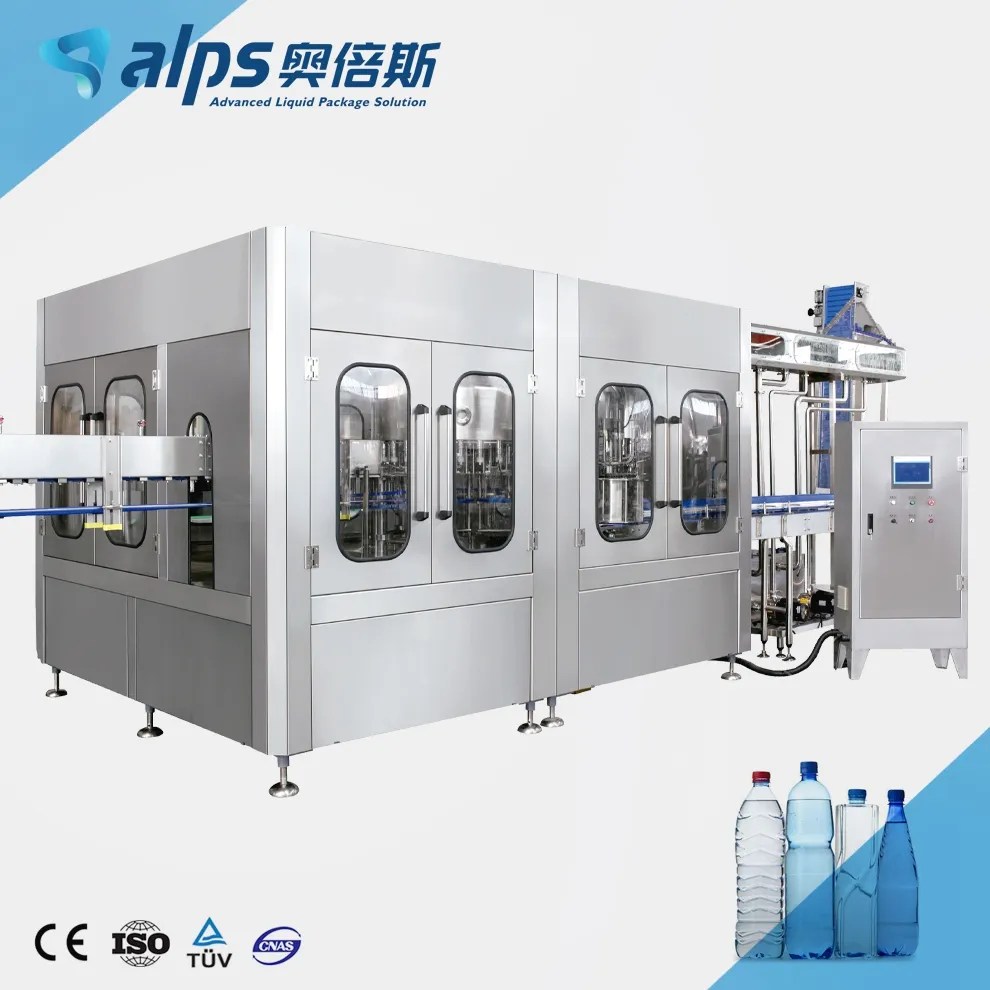
Even a well-maintained bottled water bottling line can develop operating problems. Identifying the cause early can prevent a minor issue from becoming extended downtime.
Problem | Common Cause | On-Site Solution |
Inconsistent filling volume | Calibration drift or clogged nozzles | Recalibrate filling heads and clean or replace nozzles |
Capping failure | Cap misalignment or worn capping heads | Realign the capping unit and replace worn parts |
Sensor failure | Dust, aging wiring, or weak signals | Clean sensor lenses, check wiring, and replace faulty sensors |
Nozzle dripping | Worn or hardened seals | Replace O-rings and gaskets and adjust nozzle position |
Reduced filling speed | Partial blockage, low water pressure, or pump issues | Clean nozzles and inspect the water supply and pump |
Bottle jams or tipping | Conveyor wear or guide misalignment | Adjust guides and repair or replace worn conveyors |
Early warning signs such as unusual noise, rising temperatures, and speed fluctuations should be recorded in maintenance logs. Also, deformed bottles caused by underweight preforms require coordination with the preform supplier. Before any repair, stop the machine, isolate the power supply, and follow proper safety procedures.
Reliable maintenance depends not only on equipment but also on the people and procedures behind it. Three areas deserve consistent attention:
Train Operators:
Train operators in routine maintenance and basic troubleshooting.
Combine theory, hands-on practice, and regular assessments.
Ensure new employees understand emergency stops and LOTO procedures before operating equipment.
Keep Maintenance Records:
Record every cleaning, lubrication, inspection, and repair.
Use digital logs to simplify searching, sharing, and trend analysis.
Review recurring issues to identify components that may require earlier inspection or replacement.
Follow Safety Rules:
Shut down and isolate equipment before maintenance.
Wear appropriate PPE, including gloves, eye protection, and hearing protection where required.
Test emergency stops regularly and keep them accessible.
Apply LOTO (Lockout/Tagout) procedures consistently to prevent unexpected machine startup.
A well-trained team, accurate maintenance records, and strict safety practices turn routine maintenance into a more reliable and controlled process.
Traditional maintenance relies mainly on scheduled inspections, while advanced technologies help detect potential problems earlier and reduce manual work.
CIP (Clean-in-Place) systems can clean internal pipes and tanks without extensive disassembly, improving cleaning consistency while reducing labor and human error.
Online water-quality monitoring can track parameters such as TDS, pH, and residual chlorine, helping operators identify abnormal conditions promptly.
For medium and large production lines, predictive maintenance tools such as vibration analysis, thermal imaging, oil analysis, and IoT sensors can monitor bearings, motors, gearboxes, temperature, pressure, and energy consumption.
While these technologies require additional investment, they can combine routine maintenance with condition-based monitoring, enabling beverage manufacturers to shift from reactive repair to a more proactive maintenance strategy.
A well-planned maintenance program is an investment in production stability and long-term equipment value. Regular cleaning, inspection, lubrication, calibration, and timely replacement of wear parts can reduce unplanned downtime, minimize water and packaging waste, lower emergency repair costs, and extend equipment service life. The real value of maintenance should be measured by more consistent production, improved filling accuracy, and better use of equipment capacity. By combining preventive maintenance with timely troubleshooting and advanced monitoring, beverage producers can turn maintenance from a reactive task into a structured strategy for protecting their production investment.
Alps Machine supports beverage producers with more than individual filling equipment. Its turnkey solutions cover workshop design, machine layout, and water, gas, and electrical cable planning, along with water treatment, filling, labeling, and packing systems. This integrated approach helps customers plan reliable beverage production from the line level. Looking to build an efficient bottled water production line? Contact Alps Machine to discuss your turnkey project requirements.


By continuing to use the site you agree to our privacy policy Terms and Conditions.