Advanced Liquid Package Solution
Any question?
Get in touch


Search results for beverage filling often place terms such as gravity, hot fill, rotary and monoblock in one list. They describe different design decisions. Gravity explains how product enters a container, hot fill describes a preservation route, rotary describes container movement, and monoblock describes equipment integration. Separating those labels helps a buyer compare machines on the same basis and gives a supplier a clearer specification.
Most projects can be screened in three passes: define the beverage and preservation route, decide what the filler must control, then choose a machine layout that matches the package and required output.

A complete line combines filling with container handling and downstream equipment. Source: ALPS Machinery
Layer | What it describes | Examples |
Filling principle | How product enters the container and how the dose or level is controlled | Gravity or level, volumetric, flow meter, piston, isobaric |
Process route | How the beverage and package meet the approved preservation requirement | Ambient or cold fill, hot fill, aseptic filling |
Machine layout | How containers move and which operations share one machine frame | Inline, rotary, standalone filler, monoblock, combiblock |
A machine can carry several labels at once. A rotary monoblock may use gravity valves for still water, while another rotary monoblock uses isobaric valves for a carbonated drink. The useful comparison begins by keeping each layer separate.
Gravity filling uses the liquid head above the valve to move product into the package. Level or overflow systems stop or return product when it reaches a defined height. These methods are common starting points for still, free-flowing drinks, but they do not control the same result. A level filler aims for a consistent visible line; bottle-to-bottle variation can change the quantity delivered at that line.
Specify whether acceptance is based on visible level, delivered volume or another measure. Also provide viscosity, foaming behavior, fill temperature, bottle rigidity and the permitted degree of product exposure. Vacuum or micro-vacuum arrangements need the same discipline. Ask the supplier to describe the exact cycle, package requirements and control target instead of treating vacuum as a general solution for every viscous beverage.
Volumetric systems deliver a defined quantity through a dosing chamber, timed control or electronic measurement. A flow-meter filler measures product moving through the line and closes the valve when the programmed target is reached. Electromagnetic meters measure volume flow in suitable conductive liquids; Coriolis meters measure mass flow and may also report density and temperature.
The meter is only one part of the dosing loop. Product pressure, tank level, air or foam, valve response and liquid that continues moving during shutoff can change the final dose. The specification should identify the measurement basis, product properties, fill range, calibration method and acceptance test. ALPS has a separate guide to flow-meter filling for buyers who need to compare electromagnetic, Coriolis and alternative methods.

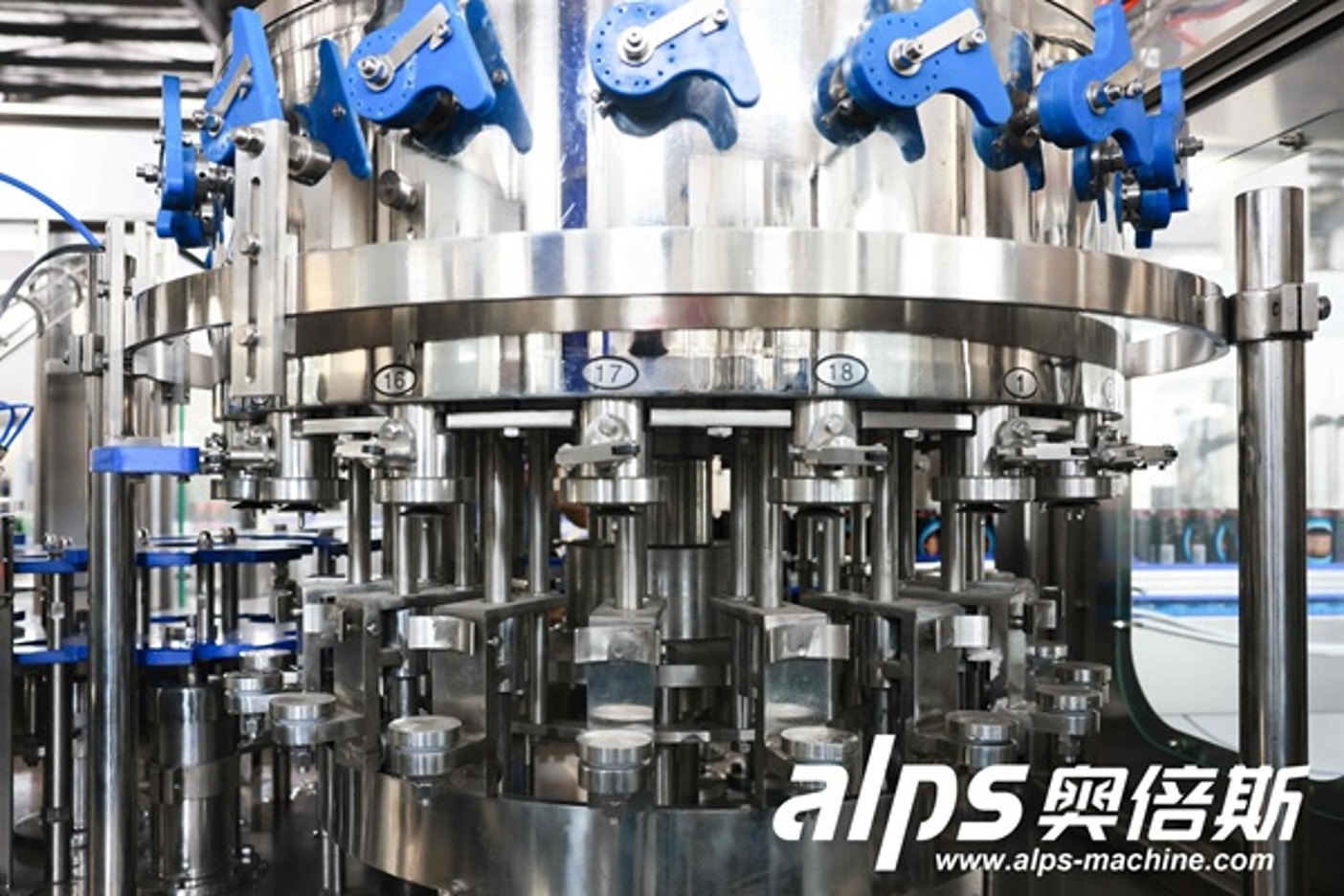
The filling principle and the rotary layout are separate parts of the machine specification. Source: ALPS Machinery
A piston filler draws product into a cylinder and then pushes a defined volume into the container. Other positive-displacement systems use a pump selected for the product. These arrangements are considered when viscosity, soft particles or a controlled mechanical dose make a simple gravity path unsuitable.
Product names are not enough for sizing. Provide viscosity at the actual filling temperature, particle size and concentration, settling behavior, allowable shear, passage diameter, cleaning method and changeover range. The supplier should test a representative product and package when flow behavior can change the valve, nozzle or achievable output.
Isobaric, or counter-pressure, filling first brings the container close to the pressure in the product tank. Product then enters through a controlled valve while displaced gas leaves through a vent or return path. The valve closes before pressure is released and the package moves to capping or seaming. This sequence helps control foam and carbon dioxide loss in sparkling water, carbonated soft drinks, beer and similar products.
Temperature and pressure must be specified together. Buyers should also define carbonation, package pressure resistance, purging needs, venting, decompression, transfer time to closure and the response to stops. A filler cannot compensate for unstable product entering the machine. The ALPS isobaric filling guide covers the valve sequence, containers and acceptance inputs in more detail.